

Introduction
In high-volume production, small inefficiencies compound fast. A machine that costs you an extra 10 seconds per cycle is a minor inconvenience at 10 parts, but nearly 28 lost hours at 10,000 parts. For shops producing medical components, aerospace fasteners, electronics housings, or firearms parts, that math hits the bottom line directly. Tight tolerances make it worse: variation from cycle to cycle creates scrap, rework, and sorting labor. Traditional approaches force a choice between speed and accuracy. Compact machining centers engineered for both eliminate that tradeoff.
Where Cycle Time Gets Lost and Recovered
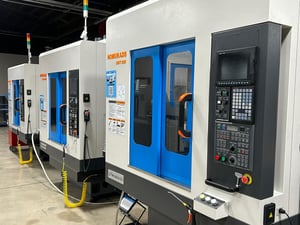
In a typical multi-operation part, cutting operations consume roughly 70% of total cycle time. The remaining 30% is non-cutting time—moving between operations, changing tools, repositioning. On a traditional 40-taper VMC, each tool change takes 3-5 seconds with rapid traverse rates of 1,000-1,500 inches per minute. At high volumes, that 30% is the primary lever for profitability. Nomura DS compact machining centers complete tool-to-tool changes in approximately 1 second with rapid traverse rates over 2,300 inches per minute—and those gains multiply across every tool change and positioning move in every cycle.
Rigidity Enables Speed with Accuracy
Speed alone isn't enough. A machine that moves quickly but chatters during cutting hasn't improved productivity. Tool life decreases, surface finishes require secondary operations, and dimensional accuracy drifts.
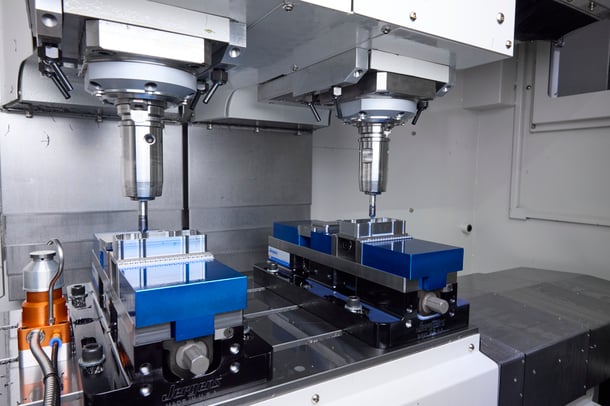
Nomura DS compact machining centers achieve rigidity through design elements working together: BBT30 dual contact spindles reduce deflection during lateral cutting forces, often times maintaining the same cutting parameters proven on larger 40-taper machines. Heavy base castings absorb dynamic forces during high-speed cutting. Roller linear guide systems provide superior rigidity compared to ball-type guides, offering enhanced dampening during interrupted cuts.
Example Scenario: Automotive Component Production
The following is a representative scenario based on typical applications. Actual results will vary based on your specific parts, materials, tooling, and production requirements.
Consider an automotive supplier producing approximately 3,000 aluminum brake caliper mounting brackets monthly across two 8-hour shifts. The part measures roughly 5.5" x 4.5" x 1.5" and requires multiple operations.
Current State: Parts run on a 40-taper VMC with approximately 5.2 minutes cycle time. With around 12 tool changes per part at roughly 4 seconds each, plus positioning moves, non-cutting time accounts for roughly 30% of cycle, or approximately 1.5 minutes. The large VMC is occupied with work that doesn’t require its full capacity.
Moving to Nomura DS DST-40L:
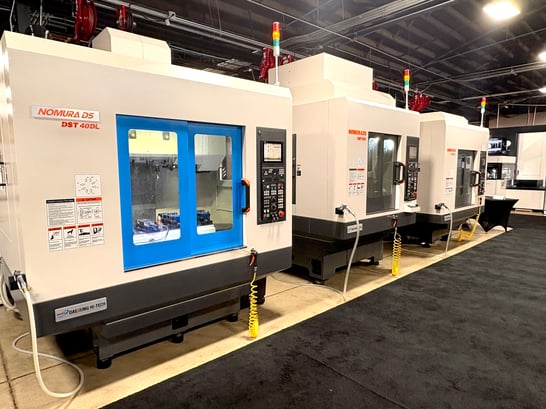
The part fits comfortably within the DST-40L’s 28.35" x 15.75" work envelope. In this example scenario, qualification trials achieve:
-
Tool change time drops from ~4 seconds to ~1 second (12 changes save roughly 36 seconds)
-
Rapid traverse improvements save an additional ~12 seconds in positioning
- Non-cutting time reduced from ~1.5 minutes to ~0.8 minutes, roughly a 48-second improvement per part
The high rigidity on Nomura DS machines allows for existing cutting parameters without modification, preserving surface finish quality and dimensional consistency.
New cycle time: Approximately 4.4 minutes per part—a reduction of roughly 48 seconds, or approximately 15% improvement.
What That Means at 3,000 Parts Per Month:
At 5.2 minutes per part, producing 3,000 brackets requires approximately 260 machine hours per month, which is well within reach for a two-shift operation with realistic utilization. At 4.4 minutes per part, that same volume requires approximately 220 hours, freeing roughly 40 hours of spindle time monthly. That capacity can absorb additional production, reduce reliance on overtime, or simply give the shop more scheduling flexibility.
Scaled further: if that freed capacity is used to run additional parts at even a modest contribution margin, the impact compounds quickly. A 15% cycle time reduction is not a rounding error. It’s a meaningful, provable gain that shows up in every part you run.
This scenario focuses exclusively on cycle time reduction, or the most direct and measurable benefit of moving high-volume small-part work to a compact machining center. It doesn’t account for the additional gains shops typically realize: lower energy consumption per part, the ability to run more spindles in the same floor space, or freeing your 40-taper VMC for the complex, high-mix work it’s better suited for. Those benefits are real, but they vary by operation. Cycle time reduction is what we can demonstrate in a controlled scenario, and it’s often enough on its own to justify the conversation.
The Bottom Line
The scenario above captures one part, one machine, one month, and it frees 40 hours of spindle time. Multiply that across a full production schedule, and the case for compact machining centers makes itself.
Ready to analyze your high-volume operations? Contact Nomura DS to discuss how compact machining centers can improve your cycle times and multiply your shop's profitability.
